Hello and welcome to my complete video course about Absolutely Continuous Functions consisting of 9 videos. This is a supplementary series to the Real Analysis series and Functional Analysis. It’s about what absolutely continuous functions are what we can do with them.
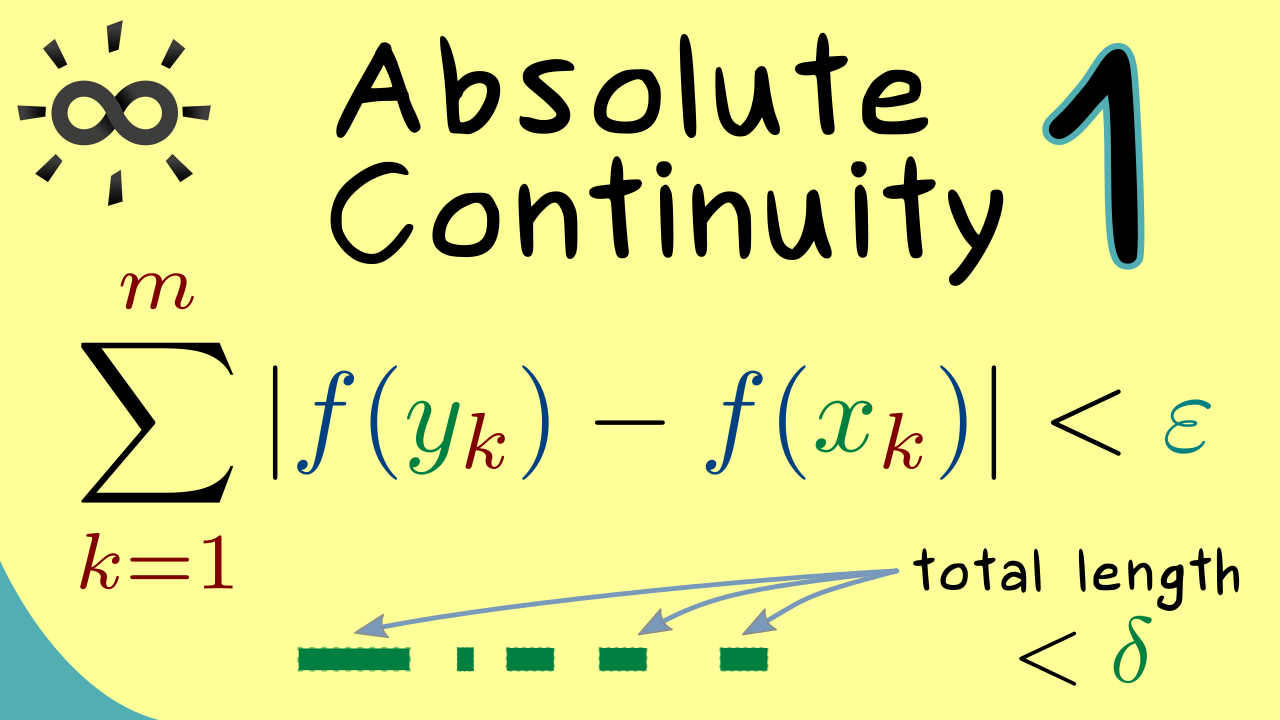
Part 1 - Definition of Absolute Continuity
Let’s start by discussing the different notions of continuity. We have pointwisely continuous functions, uniformly continuous, and absolutely continuous functions.
Part 2 - Cantor Function
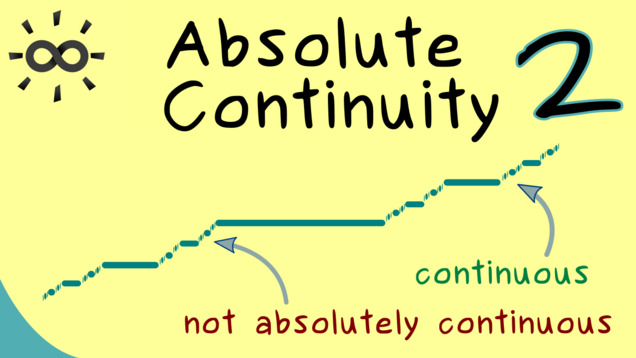
We’ve already learnt that absolutely continuous functions are uniformly continuous. However, the reverse statement is not true in general. We can actually construct a function defined on the unit interval that is continuous but not absolutely continuous. This so-called Cantor function is also related to the Cantor set.
Part 3 - Lipschitz Continuity
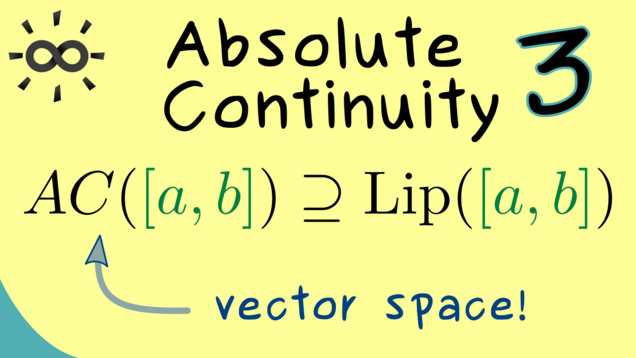
Lipschitz continuous functions play an important role for the theory of differential equations and might ask what the relation to absolutely continuous functions. It turns out that they form a subspace in the vector space of absolutely continuous functions.
Part 4 - Total Variation
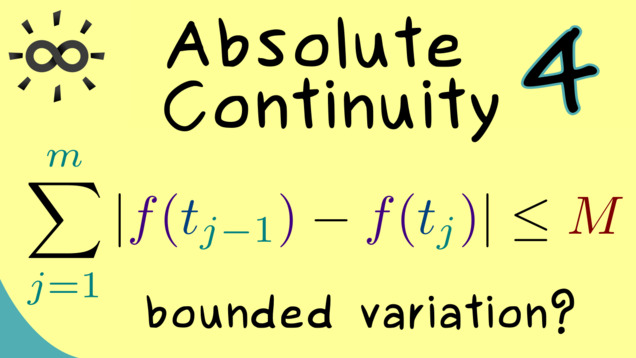
The notion of functions of bounded variation is another important one. Indeed, the variation is defined as the fluctuation of a given function over a given domain. One speak of the total variation function, which is a non-decreasing function, and the total variation, given as the largest value of this function. It turns out that the total variation function is absolutely continuous whenever the original function was already absolutely continuous. We will prove that here.
Part 5 - Absolute Continuity for Measures
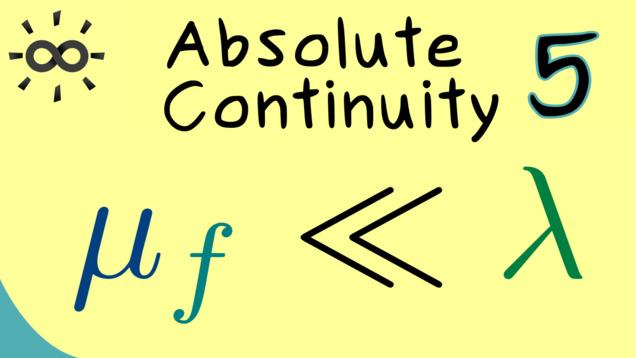
If you study measure theory, you will also stumble over the notion of absolute continuity. It compares to measure and the common symbol for that is $\mu \ll \lambda$. By using so-called Lebesgue-Stieltjes measures, one can connect this to our original definition of absolute continuous functions.
Other videos related to this topic:
- Measure Theory 12 | Carathéodory’s Extension Theorem
- Measure Theory 13 | Lebesgue-Stieltjes Measures
- Measure Theory 14 | Radon-Nikodym theorem and Lebesgue’s decomposition theorem
Part 6 - Equivalence of Absolute Continuity
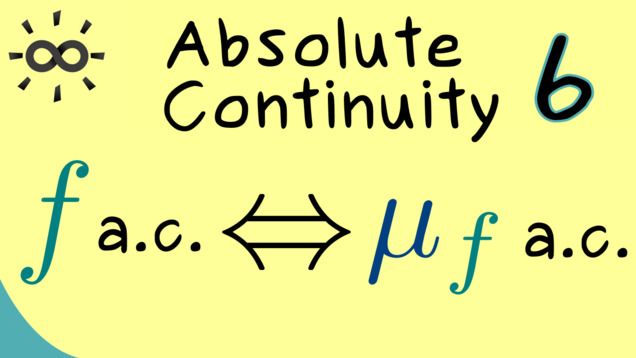
Let’s prove the equivalence between to notion of absolute continuity for a Lebesgue-Stieltes measure with respect to the Lebesgue measure and the absolute continuity of the corresponding function $f$ that defines the measure.
Part 7 - Fundamental Theorem of Calculus
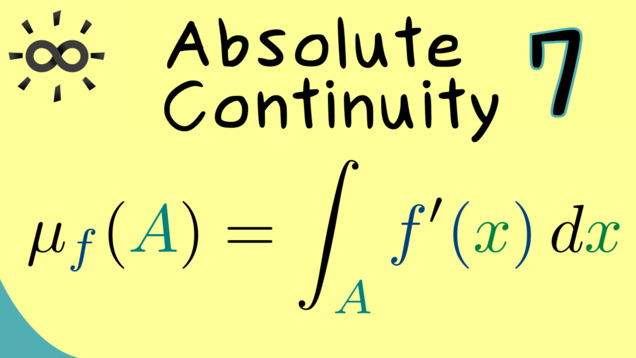
By splitting an absolute continuous into two nondecreasing functions, one can define two Lebesgue-Stieltjes measures that form a so-called charge or signed measure. In contrast to ordinary measures, these can also take negative values, but they still satisfy the $\sigma$-additivity. There is a powerful tool we can use now and it’s called the Radon–Nikodym theorem and it holds for absolutely continuous signes measures. Together with the equivalence of the two different notions of absolute continuity, we can prove the general version of the famous fundamental theorem of calculus.
Other videos related to this topic:
- Fundamental Theorem of Calculus | Expansion of the Theorem
- Measure Theory 14 | Radon-Nikodym theorem and Lebesgue’s decomposition theorem
Part 8 - Equivalence for the Fundamental Theorem of Calculus
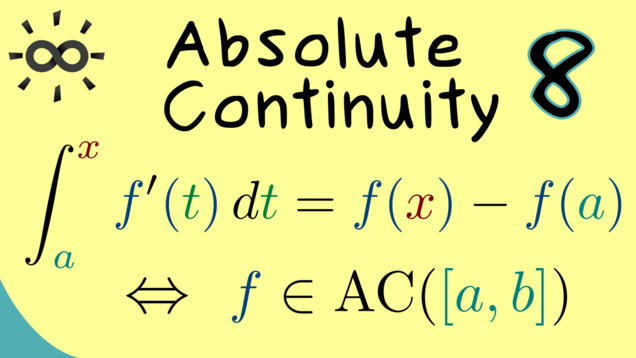
Finally, we can finish what we have started by showing the fundamental theorem of calculus is completely described by absolutely continuous fuctions. This eventually tells us why these special functions are so interesting.
Part 9 - Integration by Parts
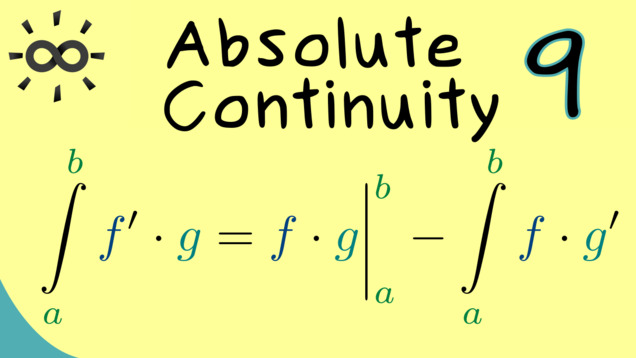
In the last video of the series, we will derive the standard integration by parts formula, but here we will do it for absolutely continuous functions. Obviously, in order to get this, we first have to show that a product of two absolutely continuous functions is also absolutely continuous again. Afterwards it’s just applying the fundamental theorem of calculus to the product rule of differentiation.
This ends this short video series about these special functions. We can use the results in other video series like Unbounded Operators.
Summary of the course Absolutely Continuous Functions
-
You can download the whole PDF here and the whole dark PDF.
-
You can download the whole printable PDF here.
- Ask your questions in the community forum about Absolutely Continuous Functions.
Ad-free version available:
Click to watch the series on Vimeo.