Hello and welcome to my ongoing video course about Distributions, already consisting of 25 videos. Alongside the videos, I provide helpful text explanations. To test your knowledge, take the quizzes and refer to the PDF versions of the lessons if needed. If you have any questions, feel free to ask in the community forum. Now, without further ado, let’s get started!
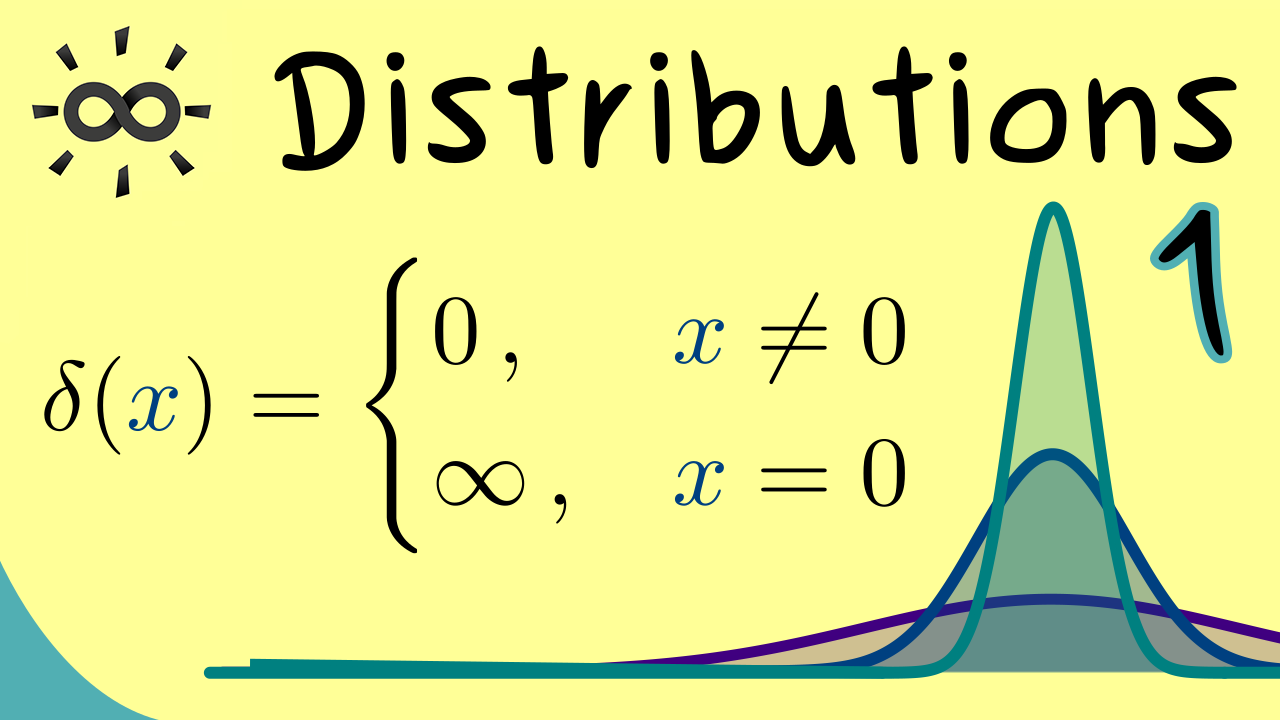
Part 1 - Motivation and Delta Function
Distributions is a video series I started for everyone who is interested in calculating with generalised functions in the realm of partial differential equations or in physics. We will start with an overview and quickly define the new concepts in a rigorous way. It will be helpful if you have some knowledge in the basics of Linear Algebra and Real Analysis. My video courses can help you there if you want to refresh your memory. Use them while watching the videos about distributions whenever you don’t understand a term we use. On the other hand, if you are interested in the topics about distributions, you might also be interested in my Functional Analysis and Measure Theory series. However, they are not necessarily needed to understand this course but still some videos could help you for getting more deep insights into the field of distributions.
Content of the video:
00:00 Intro
00:16 Analysis
01:30 Historical Example
03:55 Delta is not an ordinary function
06:10 Visualisation
8:00 Delta Function
9:20 Outro
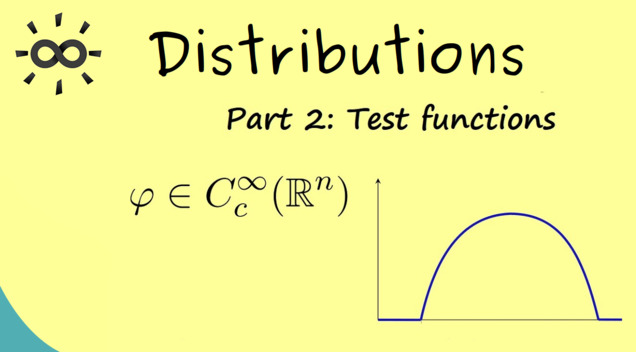
Part 2 - Test Functions
After this short historic overview, we can go into the mathematical definitions. We start by defining the so-called test functions:
Part 3 - Convergence of Test Functions
Now you know the space of test functions as a set. However, they have also some important properties, we should discuss. One that is immediately used is a notion of convergence.

Part 4 - Space of Distributions
At this point, we are ready to define the important space of distributions. It turns out that this is not so complicated when you are already familiar with linear maps.

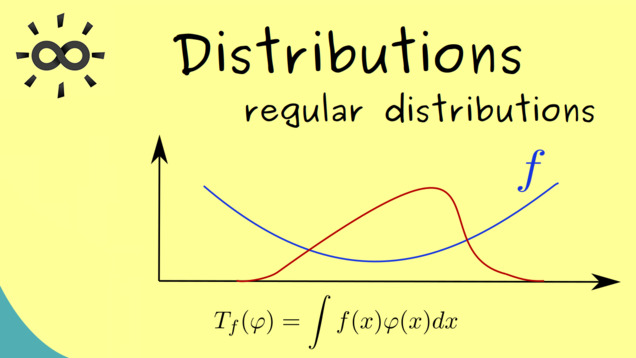
Part 5 - Regular Distributions
Next, we look at more examples for distributions. Most importantly, we will define so-called regular distributions. This will be the starting point for a lot of definitions that will follow.
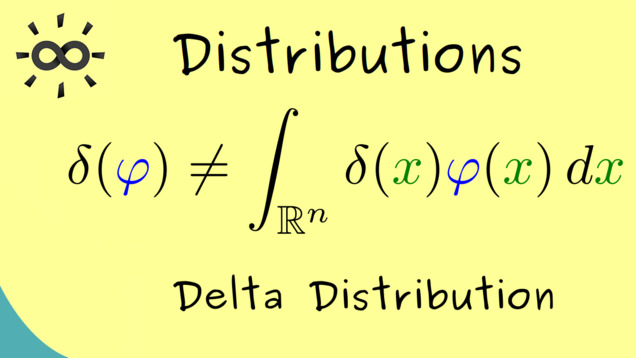
Part 6 - The Delta Distribution Is Not Regular
We have already introduced the famous delta distribution. Now, we can show that this is not a regular distribution.
Part 7 - Distributions Form a Vector Space
Let’s go one step back and look at the space we have defined. Distributions are linear functionals with an additional property: the particular continuity defined above. However, the space still, very naturally, forms a vector space. This means that we can add and scale distributions.

Part 8 - Multiplication with Smooth Functions
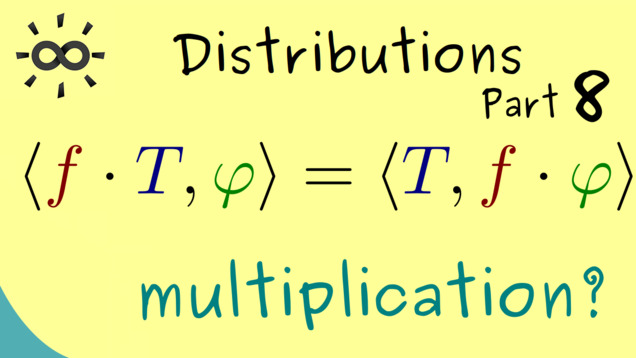
In the same way, we could define the multiplication of distributions. However, it turns out that, in general, the product of two distributions cannot be defined in the useful manner. Therefore, we restrict ourselves to the multiplication of a distribution with a smooth function.
Part 9 - Coordinate Transformation
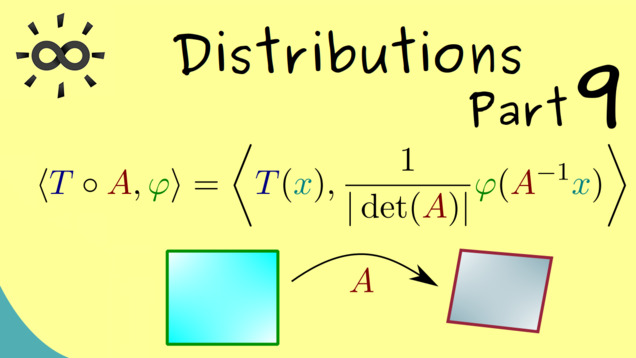
Since we are working in the n-dimensional space $ \mathbb{R}^n $, coordinate transformations are very natural. The simplest ones, can be described by invertible linear maps. Let’s see how distributions should change under such transformations.
Part 10 - Distributional Derivative
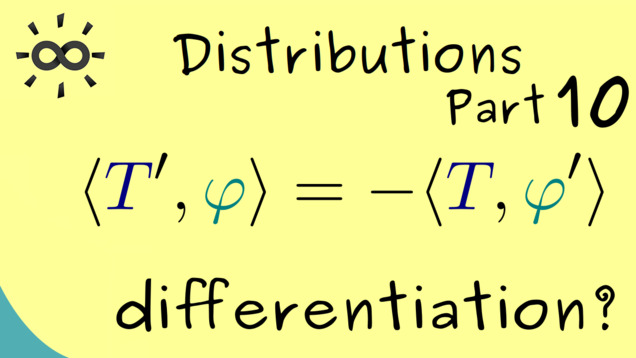
This is one of the most important definitions for distributions: we will extend the classical definition of a derivative, which only holds for smooth functions, to the whole realm of distributions, which don’t have to be smooth at all. It turns out that this extension works for every distributions such that a lot of technical problems for differential equations are already solved with this.
Part 11 - Fundamental Solution
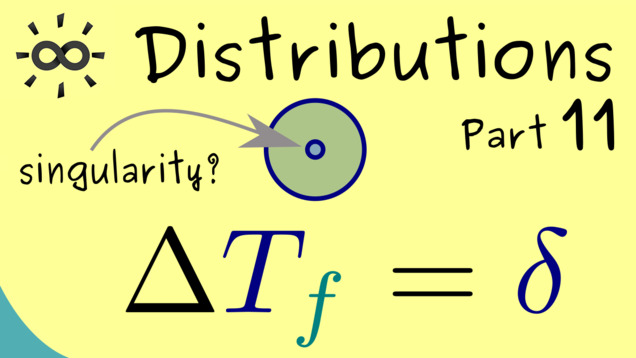
The next video is interesting for everyone who already learnt a little bit about partial differential equations. There one usually starts with an important example: the Laplace equation. For this is turns out that one has a so-called fundamental solution that helps constructing solutions for the inhomogeneous equation. By using distributions, in particular by using the delta distribution, one can put a rigourous meaning to this concept.
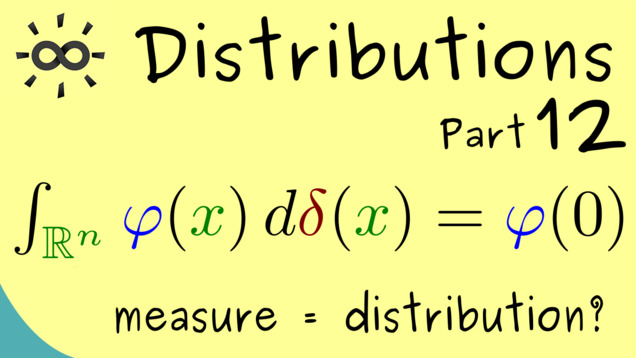
Part 12 - Finite-Order Distributions
The following video just wants to show a nice concept of some special distributions is not really needed for the rest of the series. However, it’s nice to see that some distributions coincide with ordinary measures as one learn about them in the Measure Theory series.
Part 13 - Convolution
In this video, we will first talk about the convolution as an operation for functions. Then we will also see how we can generalize this to get a convolution between test functions and distributions.

Other videos related to this topic:
Part 14 - Convolution to Solve Partial Differential Equations
Now we go deeper in the study of the convolution. First let’s show that the delta distribution acts like a neutral element there.

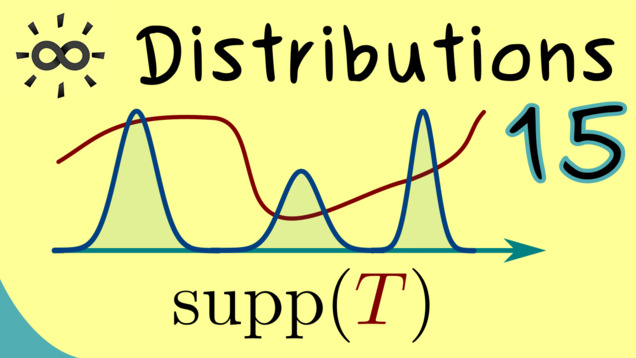
Part 15 - Support for Distributions
In order to generalize the definition of the convolutions even more, we first have to talk about the support for a distribution $T \in \mathcal{D}^\prime(\mathbb{R}^n)$. In short, it should describe at which points the distribution does not vanish. However, this requires some explanations about what this actually means because, in general, one cannot how a distribution acts on single points.
Other videos related to this topic:
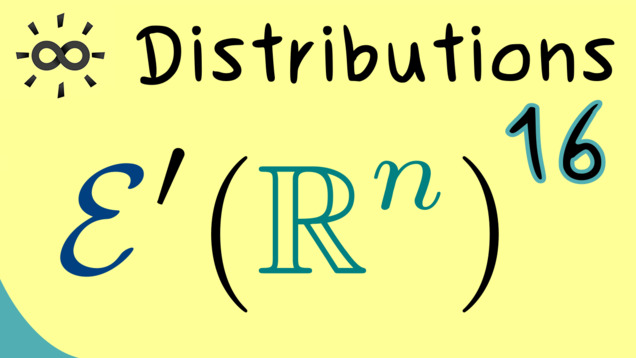
Part 16 - Distributions with Compact Support
Let’s define a subset of special distributions, denoted by $\mathcal{E}^\prime(\mathbb{R}^n)$. These are the distributions of compact support. It turns out that one can extend them to a bigger domain of definition, which we will also discuss here.
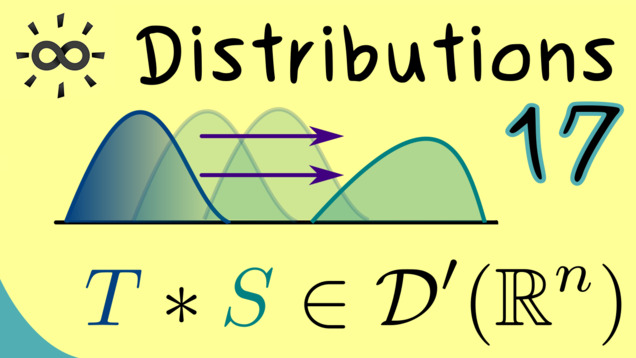
Part 17 - Convolution with Distributions of Compact Support
By using the special distributions of compact support, one can extend the definition of the convolution even more such that the convolution between two distributions makes sense.
Part 18 - Fundamental Lemma of the Calculus of Variations
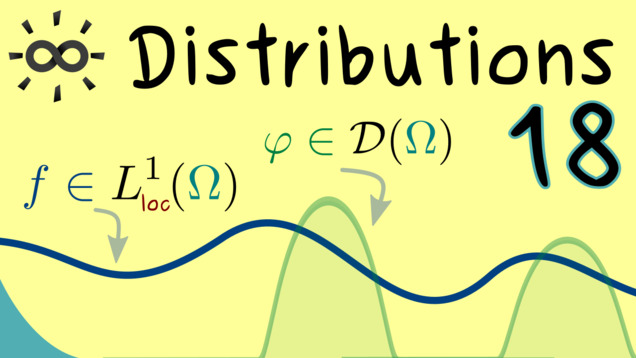
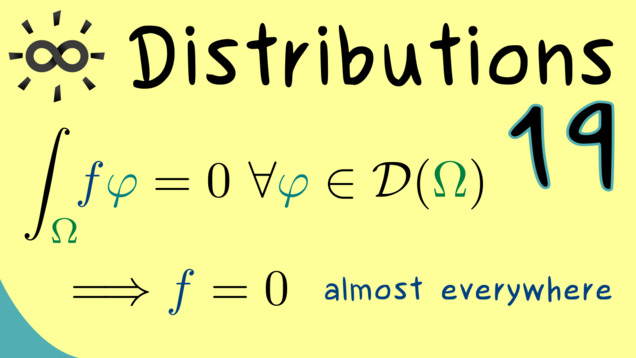
Before we continue, you should notice that all the notions in this series can also be defined for an open set $\Omega \subseteq \mathbb{R}^n$ instead of the whole space $\mathbb{R}^n$. For example, a test function $\mathcal{D}(\Omega)$ is a $C^\infty$-function that has a compact support and this one has lie completely in $\Omega$. In the same sense, we can also define distributions and locally integrable functions on $\Omega$. After this, we can also formulate the general version of the so-called fundamental lemma of the calculus of variations. This one states that testing a locally integrable function with test functions is enough to conclude that it has to be the zero function.
Part 19 - Proof of Fundamental Lemma of the Calculus of Variations
In order to prove the statement from the last video, we have to know some measure and integration theory. In particular, we can use the fact that the test functions lie dense in space of integrable functions, which is shown in my Multidimensional integration course. Combining the knowledge from there gives us the full proof:
Other videos related to this topic:
- Testing Locally Integrable Functions
- Multidimensional Integration 13 | Lebesgue Measure is Regular
- Multidimensional Integration 15 | Continuous Functions Are Dense in L¹
- Multidimensional Integration 19 | Riesz-Fischer Theorem
- Measure Theory 10 | Lebesgue’s Dominated Convergence Theorem
Part 20 - Sobolev Spaces
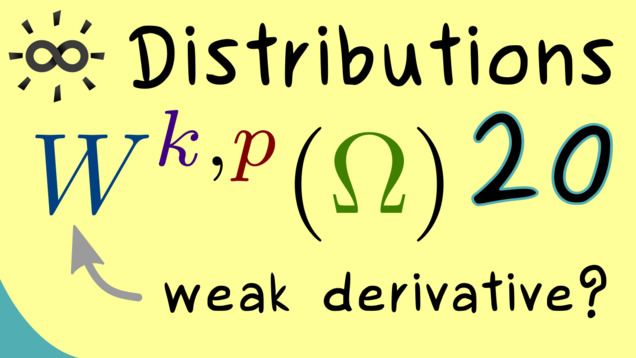
We already know that the distributional partial derivative of a distribution always exist. Now, it can definitely happen that the result is a regular distribution, which means it can be identified with a locally integrable function in $L^1_{\mathrm{loc}}(\Omega)$. If this is the case, we actually call it a weak derivative. This idea gives rise to the so-called Sobolev spaces, which combine this weak differentiability with the $p$-integrability of the $L^p$-spaces.
Other videos related to this topic:
- Multidimensional Integration 16 | Lᵖ-Spaces
- Multidimensional Integration 17 | Essentially Bounded Functions
Part 21 - Solutions of Poisson’s Equation
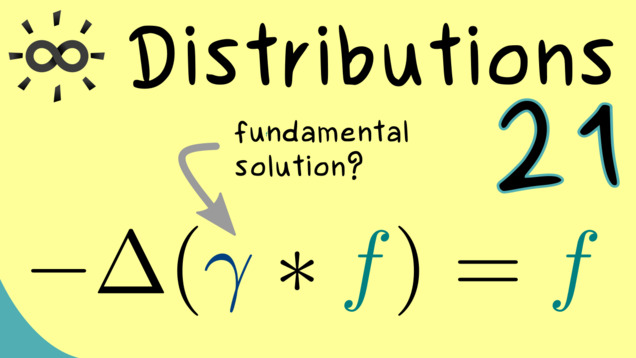
Let’s look at a common application of distributions, namely in the field of partial differential equations. There we have the fundamental solution of Laplace’s equation $\gamma: \mathbb{R}^n\setminus \{ 0 \} \rightarrow \mathbb{R}$. It’s a locally integrable function and seeing it as a distribution, we will show that $-\Delta \gamma = \delta$ holds, which explains why we rightfully speak of a fundamental solution of the differential operator $-\Delta$ in the space of distributions. Moreover, by using the distributional convolution, we can also solve Poisson’s equation $\Delta u = f$.
Other videos related to this topic:
- Distributions 11 | Fundamental Solution
- Partial Differential Equations 13 | Representation Formula for Poisson’s Equation
- Partial Differential Equations 14 | Newtonian Potential
Part 22 - Tempered Distributions
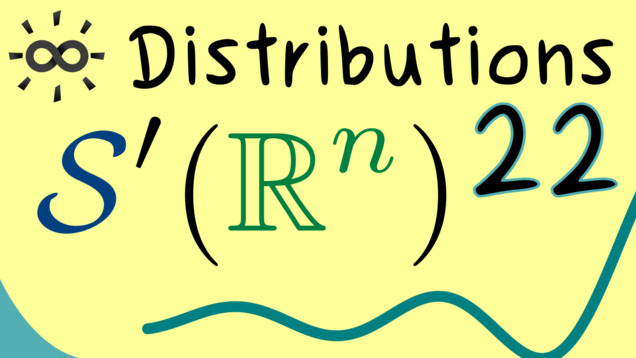
The classical Fourier transform already suggests that the Fourier transform of a constant function should be represented by something like a Dirac distribution. Therefore, we can only bring this into a mathematically sound statement by defining the Fourier transform for distributions as well. In order to this, it’s quite useful to consider the Schwartz space of rapidly decreasing functions.Since they extend the ordinary space of test functions, we get special distributions as continuous linear functionals on this space, the so-called tempered distributions.
Other videos related to this topic:
- Fourier Transform 28 | Schwartz Space
- Fourier Transform 30 | Fixed Point of Fourier Integral Transform
Part 23 - Fourier Transform
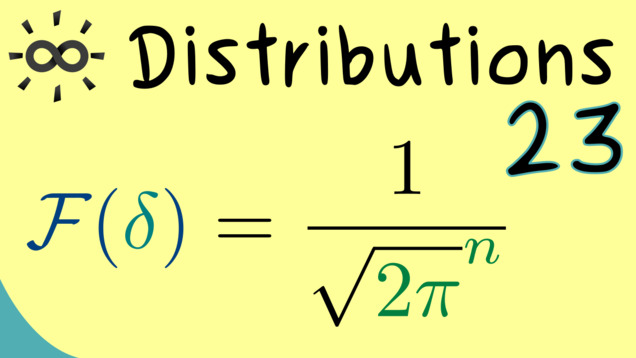
Let’s look at some examples of tempered distributions and then we are ready to define the Fourier transform of distributions for them. In particular, we can show that this definition in compatible with the old one, which means that regular distributions corresponding to integrable functions can use either of the definitions and one gets the same result. We also show that the Fourier transform of the delta distribution is the constant function.
Part 24 - Differentiation of Fourier Transform
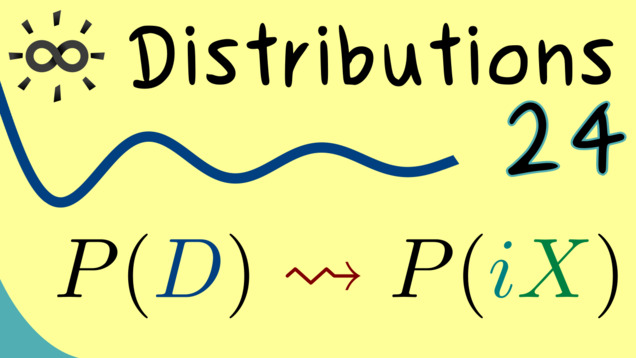
The most important property of the classical Fourier transform is that it translates differentiation into multiplication. More precisely, the Fourier transform of a linear differential operator becomes a multiplication operator with a polynomial. This nice property stays even correct for tempered distributions such that we get a tool to easily transform partial differential equations. As an application we can use the fundamental solution of Laplace’s equation to derive the generalized Fourier transform of $1/\|x\|$.
Other videos related to this topic:
Part 25 - Heat Equation with Fourier Transform
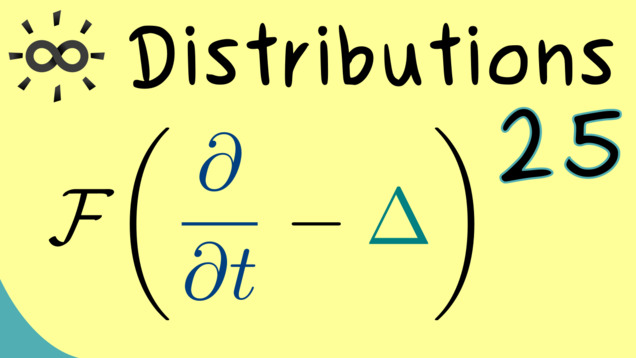
The tools from the last video can also be used to derive fundamental solutions for special PDEs. Let’s see how this works for the famous heat equation.
Other videos related to this topic:
- Ordinary Differential Equations 7 | Solving Linear Equations of First Order
- Fourier Transform 32 | Isomorphism on Schwartz Space
- Multidimensional Integration 5 | Change of Variables Formula
- Partial Differential Equations 21 | Heat Kernel - Definition
Connections to other courses
Summary of the course Distributions
-
You can download the whole PDF here and the whole dark PDF.
-
You can download the whole printable PDF here.
-
Test your knowledge in a full quiz.
- Ask your questions in the community forum about Distributions.
Ad-free version available:
Click to watch the series on Vimeo.