Hello and welcome to my ongoing video course about Basic Topology, already consisting of 19 videos. Alongside the videos, I provide helpful text explanations. To test your knowledge, take the quizzes, work through the included exercises, and refer to the PDF versions of the lessons if needed. If you have any questions, feel free to ask in the community forum. Now, without further ado, let’s get started!
Part 1 - Introduction and Open Sets in Metric Spaces
The idea of topology is to equip a set of points with a notion of closeness or neighbourhoods without actually having the need to measure distances. So it is a generalization for general metric spaces, where we have notions like open sets, closed sets, and limits. One possibility to do this is to look at the properties of open sets.

Other videos related to this topic:
Part 2 - Topological Spaces
As we have seen in the last video, the open sets in a metric space satisfy three properties. These ones we will use to define a topology on a set, which consists of a chosen collection of subsets that we call open sets. In other words, we axiomatically say which sets have to be open and they have to satisfy that finite intersections of open sets stay open and that arbitrary unions of open sets stay open. This leads to the notion of a topological space, which generalizes the concept of a metric space.

Other videos related to this topic:
Part 3 - Closed Sets and Closure
Besides the notion of open sets, we immediately get the notion of closed sets as well. These are just the complements of the open sets. By this we get that arbitrary intersections of closed sets stay closed and finite unions of closed sets stay closed. Moreover, we can also define the closure $ \overline{A} $ of any subset $A$ in a topological space. After that, we should look at an example of a topological space to see all these definitions in action.

Other videos related to this topic:
Part 4 - Compact Sets
The notion of compactness is something that is used a lot in modern mathematics. In general, this property allows to jump from local proofs to global proofs. This makes it a really useful tool in analysis. The general idea for a compact set is that it can be an infinite set but still very close to a finite set. It turned out that, in topology, the best way to describe that is by covers with open sets. Let’s look at the precise definition.

Part 5 - Closed Subsets of Compact Sets are Compact
You might remember from Real Analysis that compact sets in $\mathbb{R}$ are exactly the closed and bounded sets. It’s important to remember that this is not correct in a general topological space. However, some properties remain. For example, a closed set of a compact set stays compact.

Part 6 - Hausdorff Spaces
In this video course, we will put the focus on some special topological spaces that are especially useful in Functional Analysis, so-called Hausdorff spaces. They have the property that any two points can be separated by open sets, like we know it in metric spaces.

Part 7 - Compact Sets are Closed
Hausdorff spaces are still very general but we are able to transform a lot of properties from metric spaces. For example, it’s possible to proof that compact sets have to be closed in a Hausdorff space.

Part 8 - Locally Compact Hausdorff Spaces
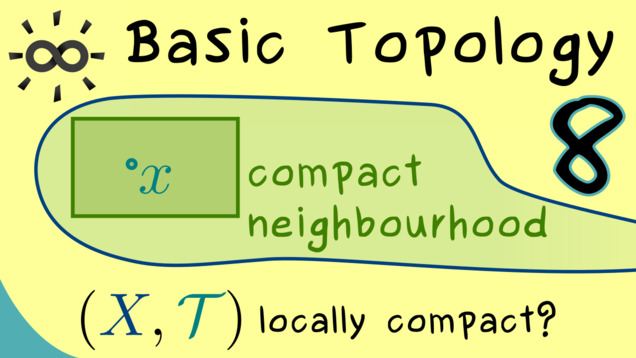
A topological space can be compact on its own. For example $[0,1]$ with the standard topology is a compact topological space. One can see that this a very strict requirement. To weaken this a little bit, one can consider locally compact topological spaces.
Part 9 - Continuity and Semicontinuity
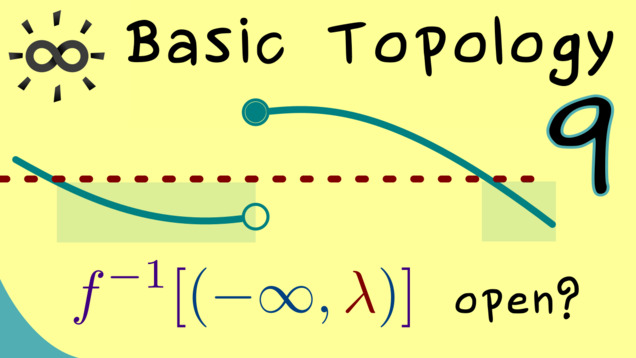
Continuous functions are studied in a lot of topics of analysis. It turns out that they are actually the basic transformations in topology, and we can just define a continuous map between two topological spaces by considering open sets and preimages. Moreover, in the case that the codomain is given by $\mathbb{R}$$, we can even define upper semicontinuous functions and lower semicontinuous functions.
Part 10 - Compact Sets Stay Compact Under Continuous Maps
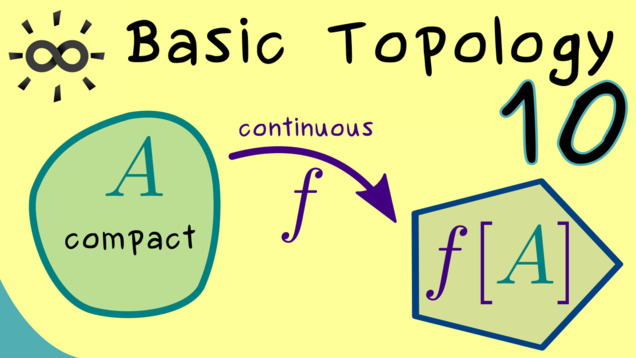
Continuous maps are very important in topology because they conserve some of the topological properties. One important theorem is that continuous images of compact sets are always compact. In order to prove this, we need to talk about properties that the image-operator and the preimage-operator have.
Other videos related to this topic:
Part 11 - Urysohn’s Lemma
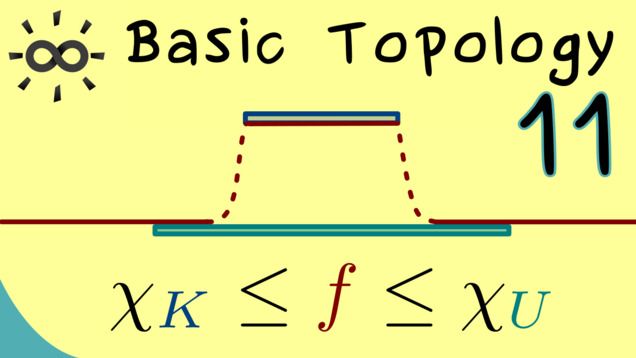
After a lot of basic proofs in topology, we finally reach our first really strong theorem about the existence of continuous function. The famous Urysohn’s lemma for locally compact Hausdorff spaces explains that for any compact set $K$, one can always find a continuous function that is constant there with value 1, but also vanishes outside of an open set $U \supset K$. This also for many constructions of continuous function and justifies the tool known as partition of unity. For formulating Urysohn’s lemma, we need to define the support of a function, $\mathrm{supp}(f)$, and the continuous functions with compact support, $C_c(X)$. Note that there also exists a different version of Urysohn’s lemma for so-called normal topological spaces, which we don’t discuss here.
Part 12 - Intermediate Compact and Open Sets
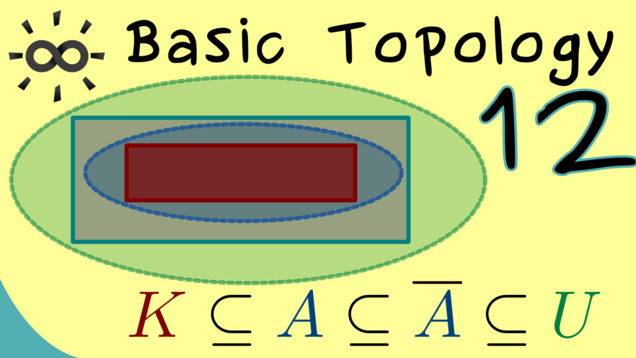
In order to prove Urysohn’s Lemma, we have to transition between a compact set and an open set. Therefore, it will be helpful to find extensions of a compact set that still lies in the larger open set. The proof of this fact will be a little bit technical, but it shows how we can work in topological spaces.
Part 13 - Proof of Urysohn’s Lemma
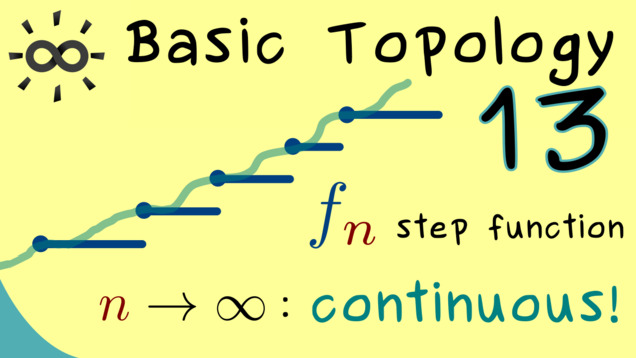
Now we have everything ready to to proof the famous result from part 11. Indeed, the proof idea is quite simple: just build a step function that goes step by step from 0 to 1. Then we just need to reduce the step width in each iteration and in the limit the continuous function should come out. Let’s fill in the details!
Part 14 - Partition of Unity
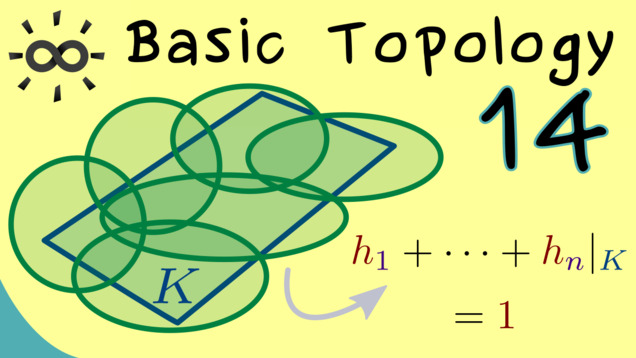
As an application of Urysohn’s Lemma, we can prove the so-called partition of unity, which allows us the split a continuous function into several parts but still conserve the properties that Urysohn’s Lemma gives us. It’s a powerful tool that can be used in different parts of analysis.
Part 15 - Connected Spaces
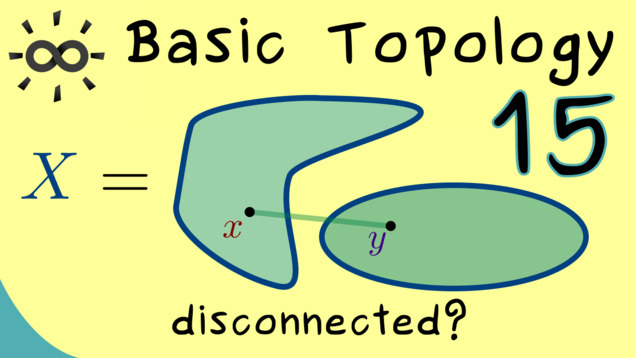
After some hard technical proofs, we can go back to some more basic topic, like connected topological spaces. The intuition behind a connected space is quite clear: it should not be possible to separate the space into two disjoint open sets, which are non-empty. Therefore, the definition is often done with so-called clopen sets. These are sets that are simultaneously open and closed. Let’s discuss the details:
Part 16 - Path-Connected Spaces
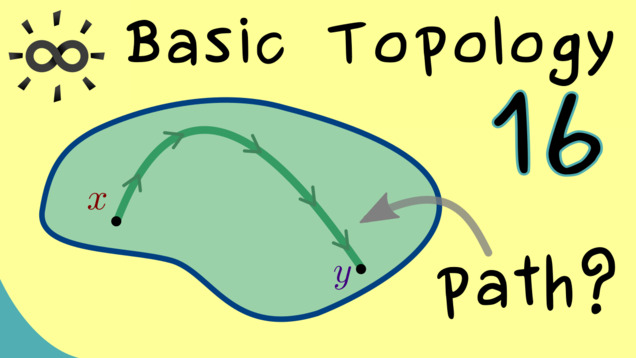
A stronger notion than the connectedness from the last video is the so-called path-connectedness. There we claim that any two points can be connected by a continuous path inside the given space. It’s quite clear that this cannot work if the space is not connected, but we will write down a formal proof of this. However, the converse claim is not so easy to see. Indeed, there are examples of connected spaces that fail to be path-connected. We will look at an explicit example of such a strange space.
Part 17 - Locally Path-Connected Spaces
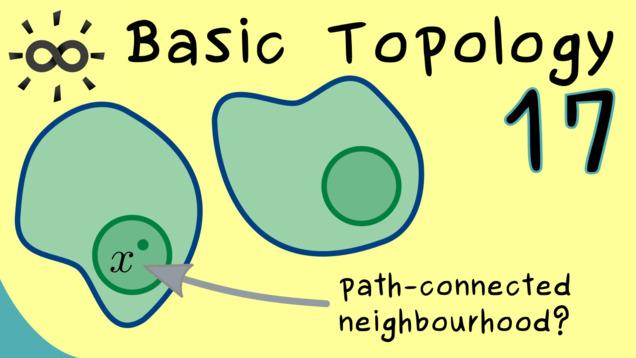
We can change the definition from the last video a little bit and get a local definition. It turns out that this is not a more general definition per se. We can have path-connected spaces that are not locally path-connected, but also locally path-connected spaces that are not (globally) path-connected. However, it’s possible to prove some relations between the different connectedness notions. For example, we can prove that an open set in $ \mathbb{R}^n $ is connected if and only it is path-connected.
Part 18 - Path-Connected Components
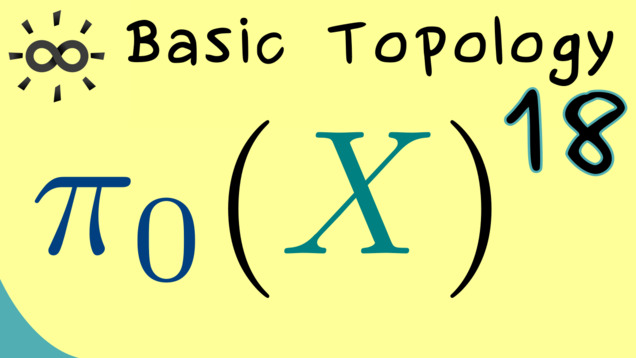
In the case that a topological space $X$ is not path-connected, we could still ask which points can be connected by a path. This immediately gives rise to an equivalence relation on $X$. Moreover, this also defines a decomposition of the space into parts that are definitely path-connected. We call them the path-connected components of the space $X$.
Part 19 - Homeomorphic Spaces
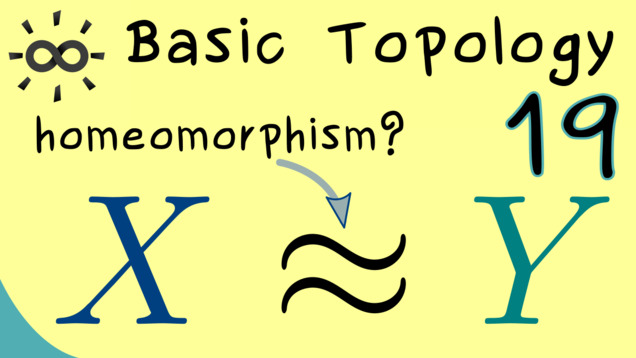
In the last video, we have proven that a path-connected component stays path-connected under a continuous transformation. Therefore, for a bijective continuous map $f: X \rightarrow Y$ where $f^{-1}$ is also continuous, we have that the number of elements in $\pi_0(X)$ is the same as the number of elements in $\pi_0(Y)$. These special maps are the isomorphisms of topological spaces and get a special shorter name: homeomorphism. Moreover, if we find such a homeomorphism between two spaces $X$ and $Y$, then we call the spaces homeomorphic and write $ X \approx Y$. From a topological point of view, these spaces are the same thing. Let’s look at examples and how we can show that two spaces are not homeomorphic.
At the moment, this was the last video in the series but not the last video about the topic of Topology. We continue developing the whole series soon.
Connections to other courses
Summary of the course Basic Topology
-
You can download the whole PDF here and the whole dark PDF.
-
You can download the whole printable PDF here.
- Ask your questions in the community forum about Basic Topology.
Ad-free version available:
Click to watch the series on Vimeo.