-
Title: Fitting Index
-
Series: Abstract Linear Algebra
-
Chapter: Some matrix decompositions
-
YouTube-Title: Abstract Linear Algebra 37 | Fitting Index
-
Bright video: Watch on YouTube
-
Dark video: Watch on YouTube
-
Ad-free video: Watch Vimeo video
-
Forum: Ask a question in Mattermost
-
Quiz: Test your knowledge
-
Dark-PDF: Download PDF version of the dark video
-
Print-PDF: Download printable PDF version
-
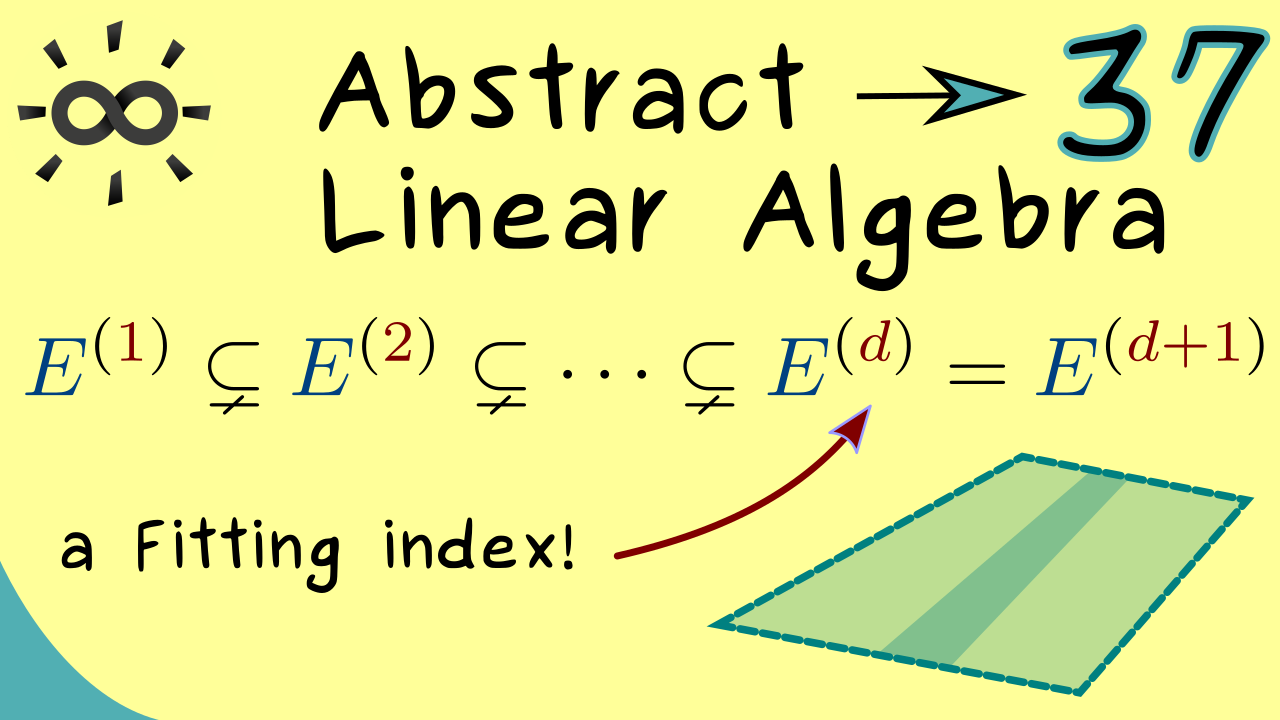
Thumbnail (bright): Download PNG
-

Thumbnail (dark): Download PNG
-
Subtitle on GitHub: ala37_sub_eng.srt missing
-
Download bright video: Link on Vimeo
-
Download dark video: Link on Vimeo
-
Definitions in the video: Fitting index for generalized eigenspaces
-
Timestamps (n/a)
-
Subtitle in English (n/a)
-
Quiz Content
Q1: Let $A \in \mathbb{C}^{n \times n}$ for $n\geq 2$ and $\lambda = 0$ be an eigenvalue. What is the correct definition of the Fitting index?
A1: The smallest $j \in \mathbb{N}$ such that $\dim(\mathrm{Ker}(A^j))$ $ = \dim(\mathrm{Ker}(A^{j+1}))$
A2: $n$
A3: $2$
A4: $\dim(\mathrm{Ker}(A)) = 2$
A5: The largest index $j \in \mathbb{N}$ such that $\dim(\mathrm{Ker}(A))$ $ = \dim(\mathrm{Ker}(A^{j}))$
Q2: Let $A \in \mathbb{C}^{n \times n}$ for $n\geq 2$ and $\lambda = 0$ be an eigenvalue. What is correct for range and kernel for every $j \in \mathbb{N}$?
A1: $\dim( \mathrm{Ran}( A^j) ) $ $+ \dim ( \mathrm{Ker}( A^j) ) $ $= n$
A2: $\dim( \mathrm{Ran}( A^j) ) $ $+ \dim ( \mathrm{Ker}( A^j) ) $ $= 0$
A3: $\dim( \mathrm{Ran}( A ) ) $ $+ \dim ( \mathrm{Ker}( A^j) ) $ $= j$
A4: $\dim( \mathrm{Ran}( A^n) ) $ $+ \dim ( \mathrm{Ker}( A^n) ) $ $= j$
A5: $\dim( \mathrm{Ran}( A) ) $ $+ \dim ( \mathrm{Ker}( A) ) $ $= 1$
Q3: Let $A \in \mathbb{C}^{n \times n}$ for $n\geq 2$ and $\lambda = 0$ be an eigenvalue. The Fitting index is denoted by $d$. If we apply $A$ to the subspace $\mathrm{Ran}( A^d)$, what subspace do we get out?
A1: $ \mathrm{Ran}( A^d )$
A2: $ \mathrm{Ran}( A^{d-1} )$
A3: $\mathbb{C}^n$
A4: $\mathbb{C}^d$
Q4: Let $A \in \mathbb{C}^{n \times n}$ for $n\geq 2$ and $\lambda = 0$ be an eigenvalue. What is not correct for the Fitting index $d$?
A1: The smallest $j \in \mathbb{N}$ such that $\dim(\mathrm{Ker}(A^j)) $ $= \dim(\mathrm{Ker}(A^{j+1}))$
A2: If $j> d$, we can have $\dim(\mathrm{Ker}(A^j)) $ $\neq \dim(\mathrm{Ker}(A^{j+1}))$
A3: If $\dim(\mathrm{Ran}(A^j)) $ $\neq \dim(\mathrm{Ran}(A^{j+1}))$, then $j \leq d$.
-
Date of video: 2024-11-29
-
Last update: 2025-10