-
Title: Application for Jordan Normal Form
-
Series: Abstract Linear Algebra
-
Chapter: Some matrix decompositions
-
YouTube-Title: Abstract Linear Algebra 44 | Application for Jordan Normal Form
-
Bright video: Watch on YouTube
-
Dark video: Watch on YouTube
-
Ad-free video: Watch Vimeo video
-
Forum: Ask a question in Mattermost
-
Quiz: Test your knowledge
-
Dark-PDF: Download PDF version of the dark video
-
Print-PDF: Download printable PDF version
-
Thumbnail (bright): Download PNG
-
Thumbnail (dark): Download PNG
-
Subtitle on GitHub: ala44_sub_eng.srt missing
-
Download bright video: Link on Vimeo
-
Download dark video: Link on Vimeo
-
Related videos:
-
Timestamps (n/a)
-
Subtitle in English (n/a)
-
Quiz Content
Q1: What is correct for every matrix $A \in \mathbb{C}^{n \times n}$?
A1: $A$ is similar to Jordan normal form where the eigenvalues of $A$ are on the diagonal.
A2: $A$ is similar to a diagonal matrix where the eigenvalues of $A$ are on the diagonal.
A3: $A$ is similar to a self-adjoint matrix.
A4: $A$ is similar to a unitary matrix.
A5: $A$ is similar to the zero matrix.
A6: $A$ is similar to a triangular matrix that has the numbers $1,2, \ldots, n$ on the diagonal.
Q2: What is correct for every matrix $A \in \mathbb{C}^{n \times n}$?
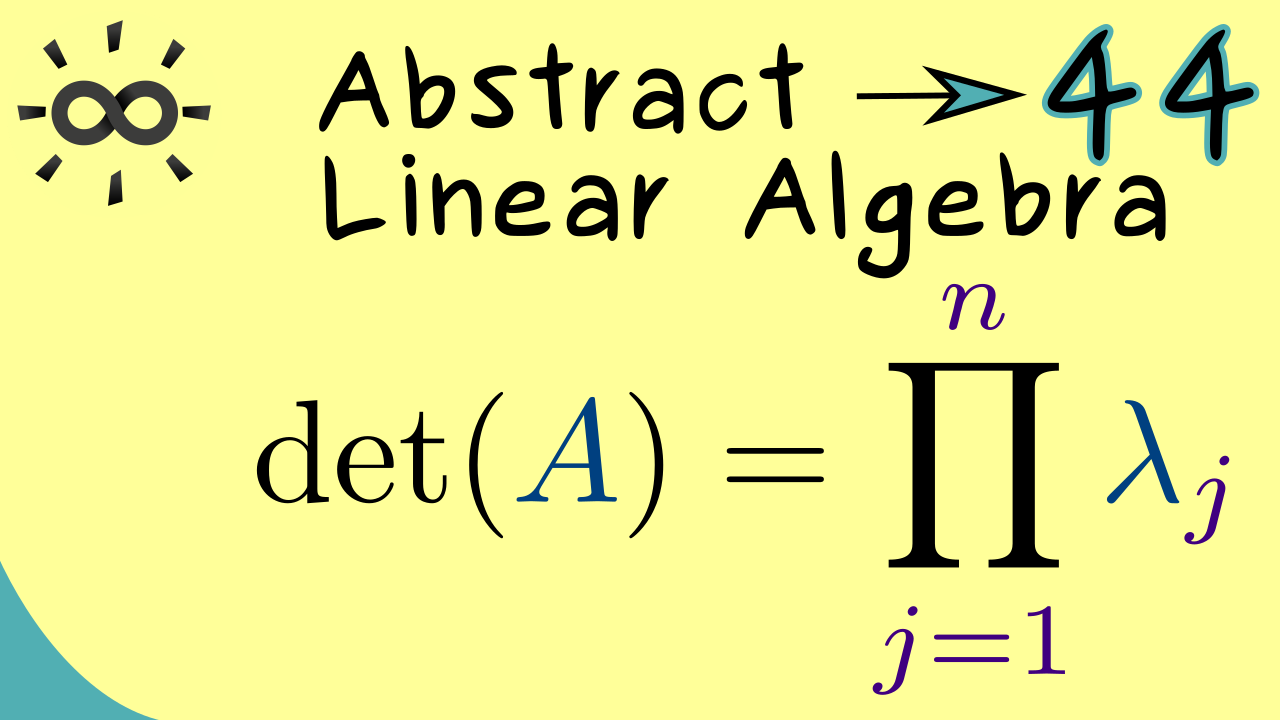

A1: $\det(A) = \prod_{j=1}^n \lambda_j$ where $\lambda_j$ are the zeros of the characteristic polynomial, counted with multiplicities.
A2: $\det(A) = \prod_{j=1}^k \lambda_j$ where $\lambda_j$ are the eigenvalues of $A$, counted by the geometric multiplicities.
A3: $\det(A) = \sum_{j=1}^k \lambda_j$ where $\lambda_j$ are the eigenvalues of $A$, counted by the geometric multiplicities.
A4: $\det(A) = \sum_{j=1}^n \lambda_j$ where $\lambda_j$ are the zeros of the characteristic polynomial, counted with multiplicities.
Q3: A Jordan normal form $J$ can be split up into two parts $D+N$. What are these matrices?
A1: $D$ is a diagonal matrix and $N$ a nilpotent matrix.
A2: $D$ is a triangular matrix and $N$ a unitary matrix.
A3: $D$ is a unitary matrix and $N$ a nilpotent matrix.
A4: $D$ is a diagonal matrix and $N$ a non-triangular matrix.
A5: $D$ is a self-adjoint matrix and $N$ an invertible matrix.
Q4: Let $J \in \mathbb{C}^{2 \times 2}$ be the Jordan normal of a matrix that has only the eigenvalue $2$ but with geometric multiplicity $1$. What is $\exp(J)$?
A1: $ \begin{pmatrix} e^2 & 0 \\ 0 & e^2 \end{pmatrix} \begin{pmatrix} 1 & 1 \\ 0 & 1 \end{pmatrix} $
A2: $ \begin{pmatrix} e^2 & 0 \\ 0 & e^2 \end{pmatrix} \begin{pmatrix} 0 & 1 \\ 0 & 0 \end{pmatrix} $
A3: $ \begin{pmatrix} e^2 & 0 \\ 0 & e^2 \end{pmatrix} \begin{pmatrix} 0 & e^1 \\ 0 & 0 \end{pmatrix} $
A4: $ \begin{pmatrix} e^2 & 0 \\ 0 & e^2 \end{pmatrix} + \begin{pmatrix} 0 & e^1 \\ 0 & 0 \end{pmatrix} $
A5: $ \begin{pmatrix} e^2 & e^2 \\ e^2 & e^2 \end{pmatrix} + \begin{pmatrix} 0 & e^1 \\ 0 & 0 \end{pmatrix} $
-
Date of video: 2025-03-07
-
Last update: 2025-10