-
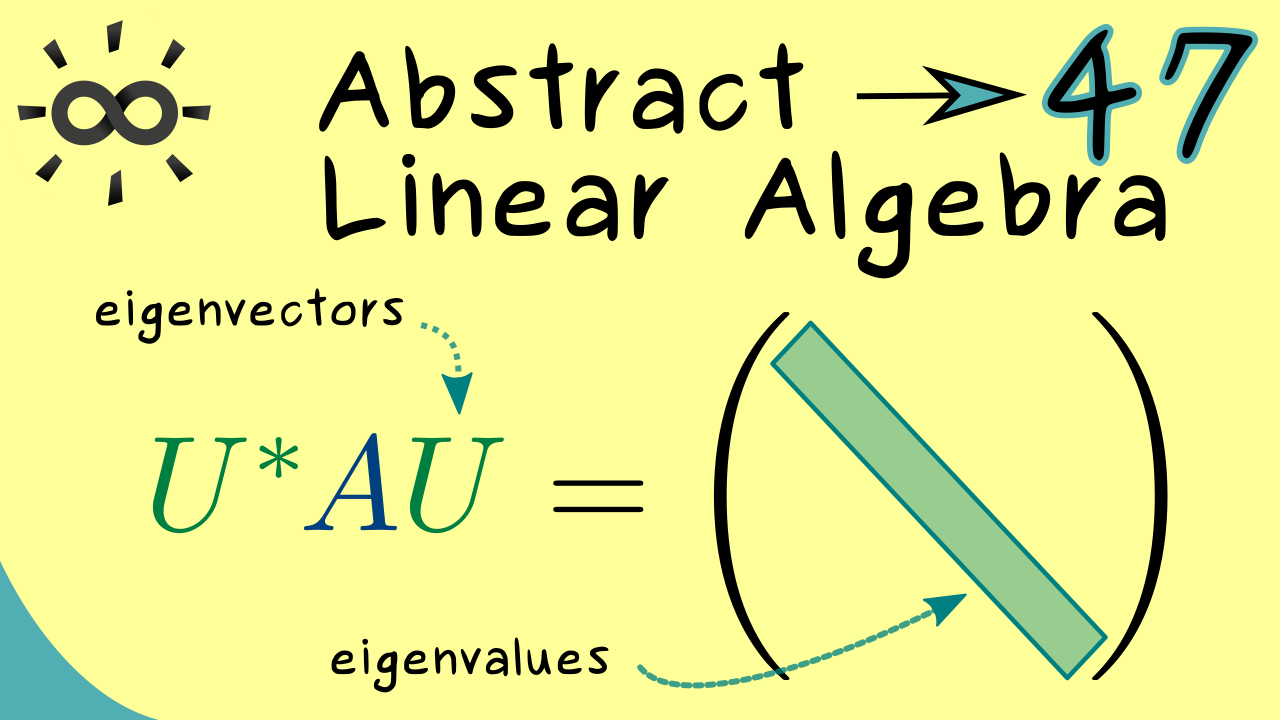
Title: Spectral Theorem for Normal Matrices
-
Series: Abstract Linear Algebra
-
Chapter: Some matrix decompositions
-
YouTube-Title: Abstract Linear Algebra 47 | Spectral Theorem for Normal Matrices
-
Bright video: Watch on YouTube
-
Dark video: Watch on YouTube
-
Ad-free video: Watch Vimeo video
-
Forum: Ask a question in Mattermost
-
Quiz: Test your knowledge
-
Dark-PDF: Download PDF version of the dark video
-
Print-PDF: Download printable PDF version
-
Thumbnail (bright): Download PNG
-
Thumbnail (dark): Download PNG
-
Subtitle on GitHub: ala47_sub_eng.srt missing
-
Download bright video: Link on Vimeo
-
Download dark video: Link on Vimeo
-
Timestamps (n/a)
-
Subtitle in English (n/a)
-
Quiz Content
Q1: Let $a, b \in \mathbb{C}\setminus\{0\}$. Which of the following matrices is normal?
A1: $\begin{pmatrix} a & b \\ b & a \end{pmatrix}$
A2: $\begin{pmatrix} a & b \\ 0 & a \end{pmatrix}$
A3: $\begin{pmatrix} 0 & 1 \\ 0 & 0 \end{pmatrix}$
A4: None of the mentioned matrices is normal.
Q2: Let $D \in \mathbb{C}^{n \times n}$ be a diagonal matrix. Do we have an ONB consisting of eigenvectors?
A1: Yes, the standard basis $(e_1, \ldots, e_n)$ will do it.
A2: No, it’s never possible.
A3: No, it could happen that $D$ is not normal and then it’s not possible.
A4: No, it’s only correct if $D$ has only real entries on the diagonal.
Q3: Let $A \in \mathbb{C}^{n \times n}$ be normal. What can we conclude by the spectral theorem?
A1: $A$ can be unitarily diagonalized.
A2: $A$ is also unitary.
A3: $A$ has $n$ different eigenvalues.
A4: $A$ has eigenspaces of dimension $2$
A5: $A$ has no eigenvectors.
A6: $A$ is diagonal.
-
Date of video: 2025-04-11
-
Last update: 2025-10