-
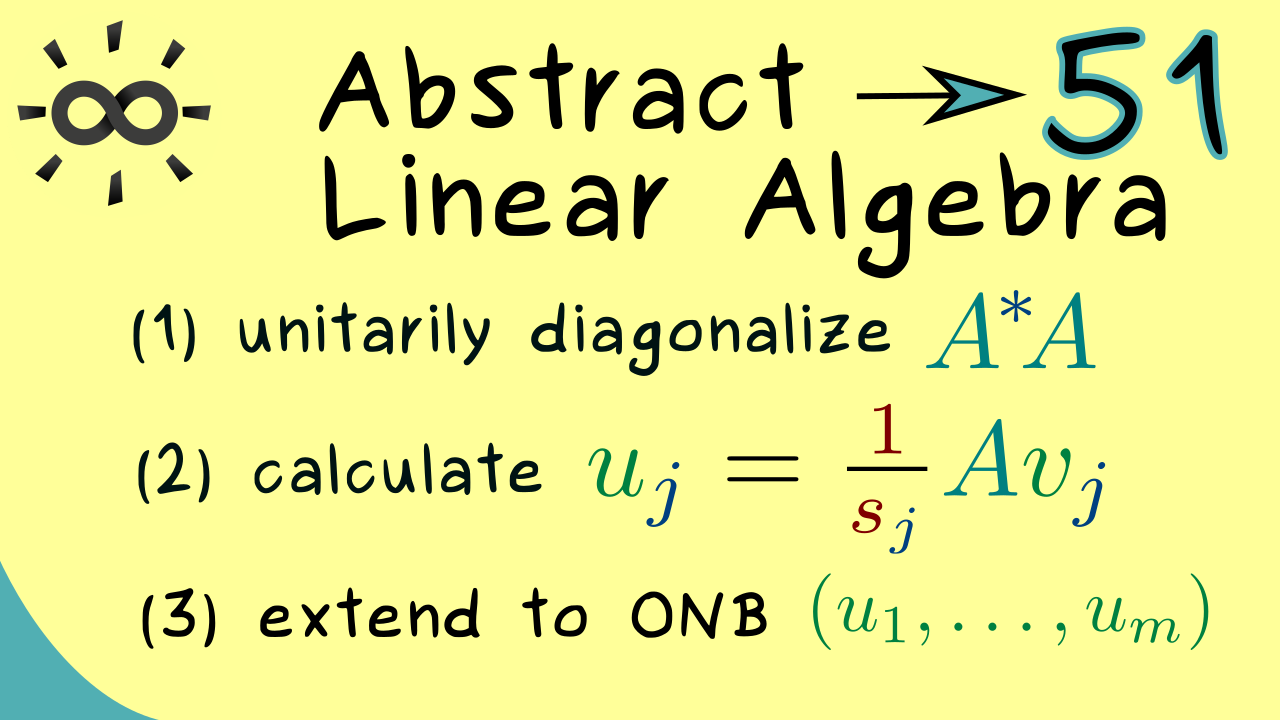
Title: Singular Value Decomposition (Algorithm and Example)
-
Series: Abstract Linear Algebra
-
Chapter: Some matrix decompositions
-
YouTube-Title: Abstract Linear Algebra 51 | Singular Value Decomposition (Algorithm and Example)
-
Bright video: Watch on YouTube
-
Dark video: Watch on YouTube
-
Ad-free video: Watch Vimeo video
-
Forum: Ask a question in Mattermost
-
Quiz: Test your knowledge
-
Dark-PDF: Download PDF version of the dark video
-
Print-PDF: Download printable PDF version
-
Thumbnail (bright): Download PNG
-
Thumbnail (dark): Download PNG
-
Subtitle on GitHub: ala51_sub_eng.srt missing
-
Download bright video: Link on Vimeo
-
Download dark video: Link on Vimeo
-
Timestamps (n/a)
-
Subtitle in English (n/a)
-
Quiz Content
Q1: Let $A \in \mathbb{C}^{5 \times 2}$. What is the first step for determining the singular value decomposition of $A$ if you want to be efficient?
A1: Calculate the eigenvalues of $A^{\ast} A$.
A2: Calculate the eigenvalues of $A A^{\ast}$.
A3: Calculate the eigenvalues of $A^{\ast}$.
A4: Calculate the eigenvalues of $A$.
Q2: Let $A \in \mathbb{C}^{5 \times 2}$. What is correct for the vectors in $V$ and the vectors in $U$?
A1: We have 2 vectors $(v_1, v_2)$ and 5 vectors $(u_1, u_2, u_3, u_4, u_5)$.
A2: Most $u_j$ are equal to zero.
A3: There are 5 vectors $(v_1, v_2, v_3, v_4, v_5)$ and their are eigenvectors of $A^\ast A$.
-
Date of video: 2025-04-30
-
Last update: 2025-10