-
Title: Projection Theorem
-
Series: Hilbert Spaces
-
Chapter: Orthogonality
-
YouTube-Title: Hilbert Spaces 9 | Projection Theorem
-
Bright video: Watch on YouTube
-
Dark video: Watch on YouTube
-
Ad-free video: Watch Vimeo video
-
Forum: Ask a question in Mattermost
-
Quiz: Test your knowledge
-
Dark-PDF: Download PDF version of the dark video
-
Print-PDF: Download printable PDF version
-
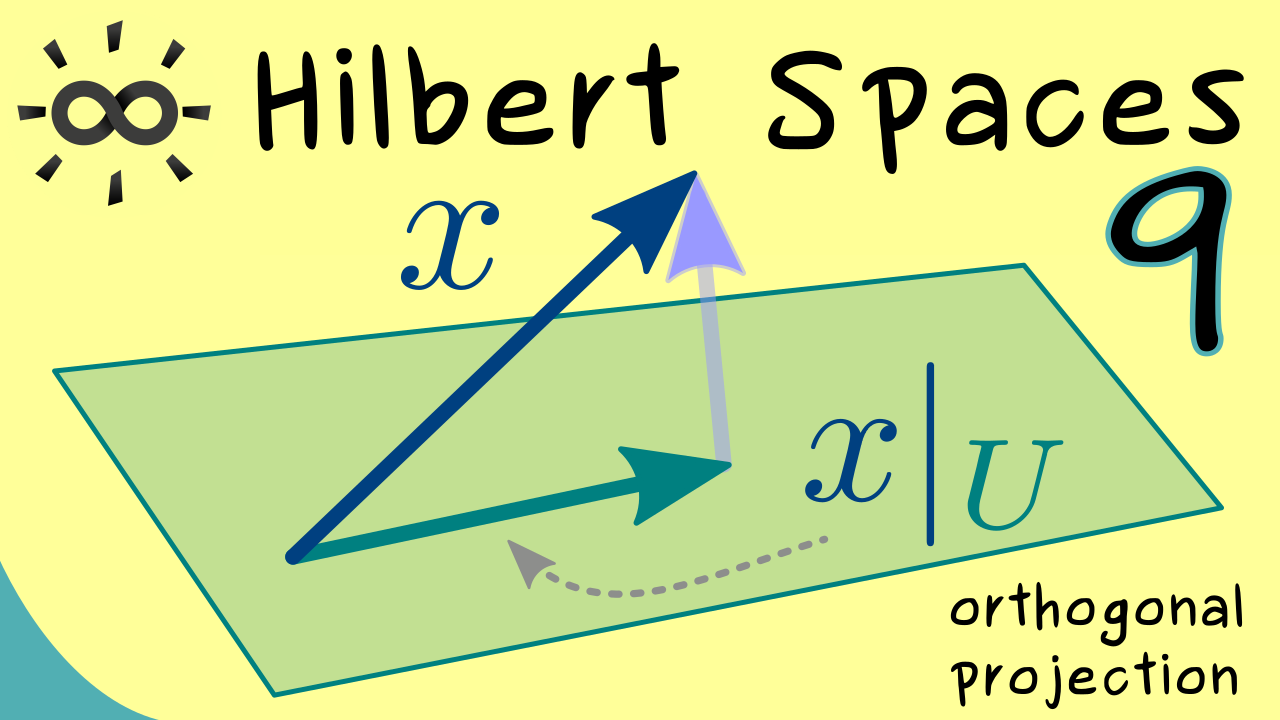
Thumbnail (bright): Download PNG
-

Thumbnail (dark): Download PNG
-
Subtitle on GitHub: hs09_sub_eng.srt missing
-
Download bright video: Link on Vimeo
-
Download dark video: Link on Vimeo
-
Definitions in the video: orthogonal projection of a vector
-
Timestamps (n/a)
-
Subtitle in English (n/a)
-
Quiz Content
Q1: Let $X$ be an inner product space and $U \subseteq X$ a subset. What can we say about the intersection $ U \cap U^\perp$?
A1: It’s either empty or $ U \cap U^\perp = \{ 0 \} $.
A2: It’s empty.
A3: It always satisfies $ U \cap U^\perp = \{ 0 \} $.
A4: It satisfies $ U \cap U^\perp \supseteq \{ 0 \} $.
Q2: Let $X$ be an inner product space and $U \subseteq X$ be a subspace. Let $p + n = \tilde{p} + \tilde{n}$ for $p, \tilde{p} \in U$ and $n, \tilde{n} \in U^\perp$. What is always correct?
A1: $p = \tilde{p}$ and $n = \tilde{n}$.
A2: $p = 0$ and $n = 0$.
A3: $p = 0$ or $n = 0$.
A4: $p - \tilde{p} = n$
Q3: Let $X$ be an inner product space and $U \subseteq X$ be a closed subspace. For $x \in X$, let’s define $p \in U$ as the unique best approximation. What is always correct?
A1: $x - p \in U^\perp$
A2: $x - p = 0$
A3: $p = 0$
A4: $n = 0$
A5: $x + p \perp U$.
-
Date of video: 2025-02-13
-
Last update: 2026-02