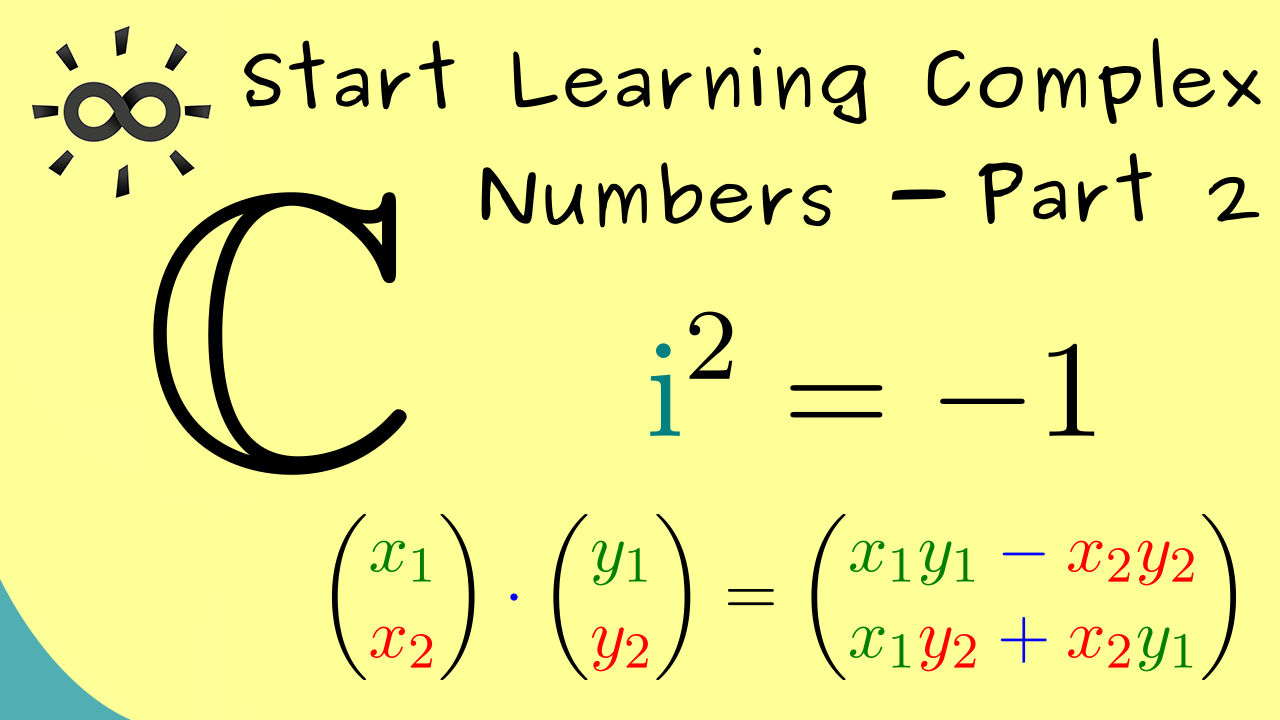

-
Title: Definition
-
Series: Start Learning Complex Numbers
-
Parent Series: Start Learning Mathematics
-
Chapter: Complex Numbers
-
YouTube-Title: Start Learning Complex Numbers 2 | Definition
-
Bright video: Watch on YouTube
-
Dark video: Watch on YouTube
-
Ad-free video: Watch Vimeo video
-
Original video for YT-Members (bright): Watch on YouTube
-
Original video for YT-Members (dark): Watch on YouTube
-
Forum: Ask a question in Mattermost
-
Quiz: Test your knowledge
-
Dark-PDF: Download PDF version of the dark video
-
Print-PDF: Download printable PDF version
-
Thumbnail (bright): Download PNG
-
Thumbnail (dark): Download PNG
-
Subtitle on GitHub: slc02_sub_eng.srt missing
-
Download bright video: Link on Vimeo
-
Download dark video: Link on Vimeo
-
Definitions in the video: field of complex numbers
-
Timestamps (n/a)
-
Subtitle in English (n/a)
-
Quiz Content
Q1: If we ignore the multiplication on $\mathbb{C}$, can we see say $\mathbb{C}$ is given by $\mathbb{R^2}$?
A1: Yes.
A2: No.
Q2: What is the product of the two complex numbers $a + i b$ and $a - i b$?
A1: $a^2 + b^2$
A2: $a^2 - b^2$
A3: $a^2 - i b^2$
A4: $i a^2 - b^2$
Q3: Can we define $z < w $ for two complex numbers $ z, w \in \mathbb{C}$?
A1: Yes, one can define such an order but it will not have the nice properties like we have them in $\mathbb{R}$.
A2: No, it’s not possible.
A3: No, one can only define $z \leq w$.
-
Last update: 2024-10