-
Title: Integers (Multiplication)
-
Series: Start Learning Numbers
-
Parent Series: Start Learning Mathematics
-
Chapter: Numbers
-
YouTube-Title: Start Learning Numbers 8 | Integers (Multiplication)
-
Bright video: Watch on YouTube
-
Dark video: Watch on YouTube
-
Ad-free video: Watch Vimeo video
-
Forum: Ask a question in Mattermost
-
Quiz: Test your knowledge
-
Dark-PDF: Download PDF version of the dark video
-
Print-PDF: Download printable PDF version
-
Thumbnail (bright): Download PNG
-
Thumbnail (dark): Download PNG
-
Subtitle on GitHub: sln08_sub_eng.srt missing
-
Download bright video: Link on Vimeo
-
Download dark video: Link on Vimeo
-
Timestamps (n/a)
-
Subtitle in English (n/a)
-
Quiz Content
Q1: We already know the integers $\mathbb{Z}$ form an abelian Group with respect to the addition. However, we can also define a second operation, which we call multiplication. What is the correct definition for equivalence classes?
A1: $[(a,b)] \cdot [(x,y)] $ $ = [(a x + b y, a y + b x) ]$
A2: $[(a,b)] \cdot [(x,y)] $ $ = [(a y + b x, a x + b y) ]$
A3: $[(a,b)] \cdot [(x,y)] $ $ = [(a x + b y, a x + b y) ]$
A4: $[(a,b)] \cdot [(x,y)] $ $ = [(a y + b x, a y + b x) ]$
A5: $[(a,b)] \cdot [(x,y)] $ $ = [(a y + b x, a b + x y) ]$
Q2: What is not a property of $\mathbb{Z}$ together with the multiplication?
A1: For all $m \in \mathbb{Z}$ there is an inverse $\tilde{m} \in \mathbb{Z}$ with $m \cdot \tilde{m} = 1$.
A2: associative
A3: commutative
A4: distributive
A5: There is an element $1 \in \mathbb{Z}$ with $m \cdot 1 = m$ for all $m \in \mathbb{Z}$.
Q3: What is correct with the definition of the multiplication?
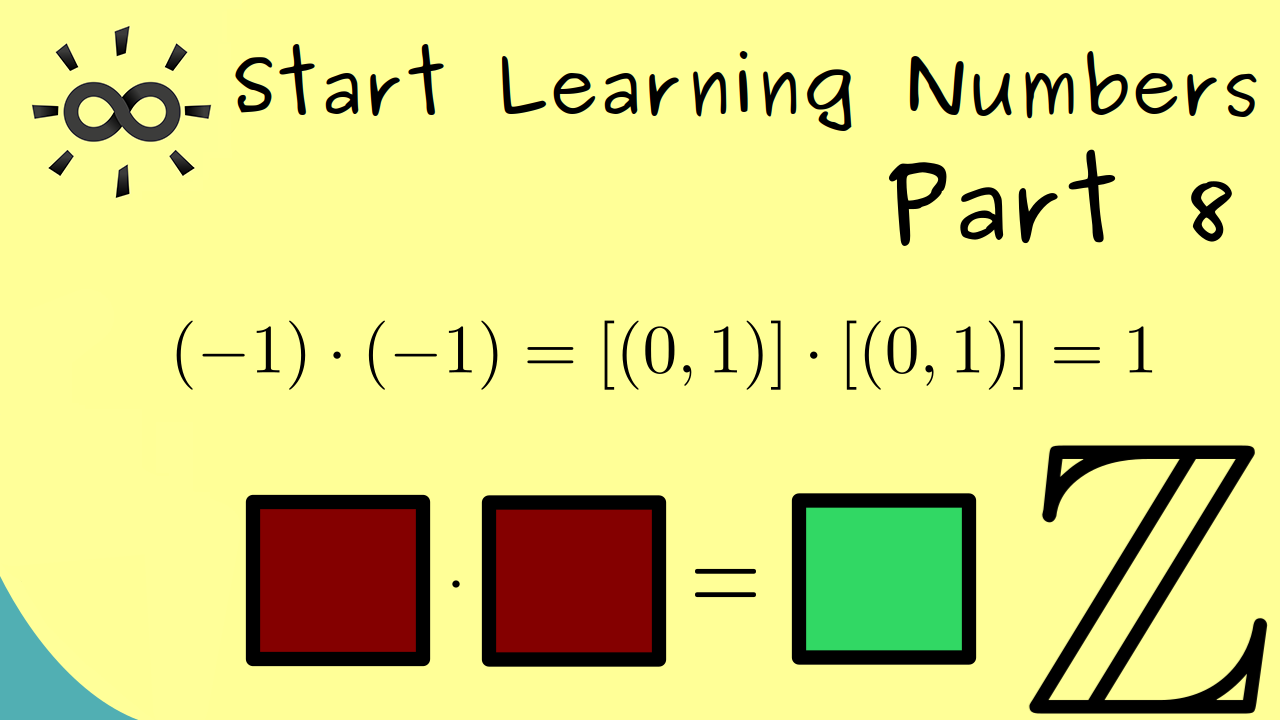
A1: $(-1) \cdot (-1) = 1$
A2: $(-1) \cdot 1 = 1$
A3: $1 \cdot 1 = -1$
A4: $1 \cdot (-1) = 1$
-
Last update: 2025-07