-
Title: Overview and Element Relation
-
Series: Start Learning Sets
-
Parent Series: Start Learning Mathematics
-
Chapter: Sets and Maps
-
YouTube-Title: Start Learning Sets 1 | Overview and Element Relation
-
Bright video: Watch on YouTube
-
Dark video: Watch on YouTube
-
Ad-free video: Watch Vimeo video
-
Forum: Ask a question in Mattermost
-
Quiz: Test your knowledge
-
Dark-PDF: Download PDF version of the dark video
-
Print-PDF: Download printable PDF version
-

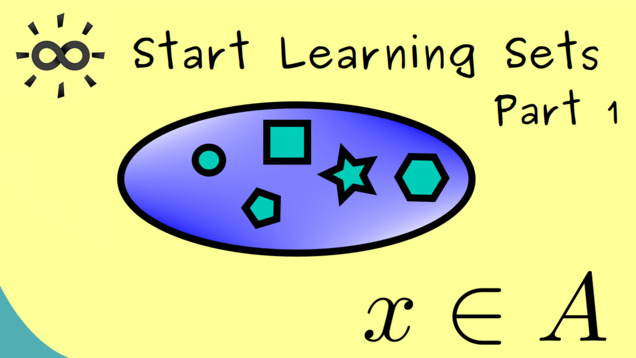
Thumbnail (bright): Download PNG
-
Thumbnail (dark): Download PNG
-
Subtitle on GitHub: sls01_sub_eng.srt
-
Download bright video: Link on Vimeo
-
Download dark video: Link on Vimeo
-
Definitions in the video: set, element in set
-
Timestamps (n/a)
-
Subtitle in English
1 00:00:00,299 –> 00:00:05,400 hello and welcome to start learning sets
2 00:00:03,720 –> 00:00:07,799 a video course where I give you a quick
3 00:00:05,400 –> 00:00:10,200 introduction into set theory
4 00:00:07,799 –> 00:00:12,420 however first many many thanks to all
5 00:00:10,200 –> 00:00:14,940 the nice people on Steady or PayPal who
6 00:00:12,420 –> 00:00:17,340 make these videos possible now for
7 00:00:14,940 –> 00:00:19,140 learning mathematics set theory is so
8 00:00:17,340 –> 00:00:21,480 important because you can describe
9 00:00:19,140 –> 00:00:24,420 everything in mathematics using just
10 00:00:21,480 –> 00:00:26,939 sets indeed you could see the field of
11 00:00:24,420 –> 00:00:29,160 logic together with the set theory as
12 00:00:26,939 –> 00:00:31,619 the foundation of mathematics
13 00:00:29,160 –> 00:00:34,260 this works as follows in the language of
14 00:00:31,619 –> 00:00:37,200 logic we describe the axioms we want the
15 00:00:34,260 –> 00:00:39,480 axioms of set theory this means that we
16 00:00:37,200 –> 00:00:40,440 have a list of propositions assumed to
17 00:00:39,480 –> 00:00:42,660 be true
18 00:00:40,440 –> 00:00:44,399 then that’s our starting point we have
19 00:00:42,660 –> 00:00:46,020 to start somewhere we have to put
20 00:00:44,399 –> 00:00:48,660 something in first
21 00:00:46,020 –> 00:00:51,360 and all the things we logically get out
22 00:00:48,660 –> 00:00:53,879 form our world of mathematics
23 00:00:51,360 –> 00:00:55,739 in this way we then reach our goal we
24 00:00:53,879 –> 00:00:58,680 can do mathematics
25 00:00:55,739 –> 00:01:00,780 however this path is way too long and
26 00:00:58,680 –> 00:01:02,879 needs a lot of time such that you should
27 00:01:00,780 –> 00:01:05,640 never do that at the beginning of your
28 00:01:02,879 –> 00:01:07,680 mathematical career thankfully there is
29 00:01:05,640 –> 00:01:09,720 a very nice shortcut that works so good
30 00:01:07,680 –> 00:01:13,500 that you can do a lot of mathematics
31 00:01:09,720 –> 00:01:15,240 without bothering about the axioms on
32 00:01:13,500 –> 00:01:17,760 this path we just learned a little bit
33 00:01:15,240 –> 00:01:20,460 of propositional logic and something we
34 00:01:17,760 –> 00:01:22,320 call naive set theory okay the name
35 00:01:20,460 –> 00:01:24,540 seems a little bit strange we will just
36 00:01:22,320 –> 00:01:26,460 call it set theory and indeed the only
37 00:01:24,540 –> 00:01:28,080 difference is that we don’t write down
38 00:01:26,460 –> 00:01:30,420 all the axioms
39 00:01:28,080 –> 00:01:33,240 with this and the propositional logic we
40 00:01:30,420 –> 00:01:35,220 learned in the last videos we can go to
41 00:01:33,240 –> 00:01:37,500 doing mathematics
42 00:01:35,220 –> 00:01:40,140 Now by having this picture in mind let’s
43 00:01:37,500 –> 00:01:42,659 go to the start of set theory
44 00:01:40,140 –> 00:01:43,500 so let’s start by saying what
45 00:01:42,659 –> 00:01:45,840 a set is.
46 00:01:43,500 –> 00:01:48,479 one often says a set is just a
47 00:01:45,840 –> 00:01:51,360 collection of distinct objects into a
48 00:01:48,479 –> 00:01:52,799 whole. So the idea would be if we have
49 00:01:51,360 –> 00:01:55,140 some objects
50 00:01:52,799 –> 00:01:57,840 for example here four different objects
51 00:01:55,140 –> 00:01:59,159 then the set puts them all together into
52 00:01:57,840 –> 00:02:01,020 a collection
53 00:01:59,159 –> 00:02:03,479 there see this is not a correct
54 00:02:01,020 –> 00:02:05,399 definition it’s just the idea we have in
55 00:02:03,479 –> 00:02:07,500 mind written down
56 00:02:05,399 –> 00:02:09,599 hence it means that by putting the
57 00:02:07,500 –> 00:02:12,900 objects together we get out a new thing
58 00:02:09,599 –> 00:02:15,420 we could call here the set M so what
59 00:02:12,900 –> 00:02:17,220 makes the set M are the objects so we
60 00:02:15,420 –> 00:02:19,080 have a natural relation between the
61 00:02:17,220 –> 00:02:21,060 objects and the set
62 00:02:19,080 –> 00:02:24,239 now in order to make everything easier
63 00:02:21,060 –> 00:02:27,360 we call such an object x inside a set M
64 00:02:24,239 –> 00:02:30,420 just an element of M
65 00:02:27,360 –> 00:02:31,379 or even better we use a short formula
66 00:02:30,420 –> 00:02:34,560 for this
67 00:02:31,379 –> 00:02:37,080 so we use this special e for element and
68 00:02:34,560 –> 00:02:38,879 read it as X in m
69 00:02:37,080 –> 00:02:41,640 so for the example on the right hand
70 00:02:38,879 –> 00:02:43,500 side we would write the circle with A is
71 00:02:41,640 –> 00:02:46,440 an element of M
72 00:02:43,500 –> 00:02:48,480 moreover If x is not such an object of
73 00:02:46,440 –> 00:02:51,239 the collection we write a similar thing
74 00:02:48,480 –> 00:02:53,519 x is not an element in M
75 00:02:51,239 –> 00:02:54,420 there we would use the line through the
76 00:02:53,519 –> 00:02:56,340 e
77 00:02:54,420 –> 00:02:59,459 now on the right hand side for the
78 00:02:56,340 –> 00:03:01,260 example we would write this D is not an
79 00:02:59,459 –> 00:03:03,300 element in M
80 00:03:01,260 –> 00:03:05,940 now at this point because you know some
81 00:03:03,300 –> 00:03:08,400 logic I can say that this new notation
82 00:03:05,940 –> 00:03:10,440 is just a short notation for the
83 00:03:08,400 –> 00:03:12,239 negation of this statement
84 00:03:10,440 –> 00:03:15,360 there you have it we see the element
85 00:03:12,239 –> 00:03:18,180 relations as logical statements
86 00:03:15,360 –> 00:03:20,879 and because a set is defined by these
87 00:03:18,180 –> 00:03:23,340 element relations we can just define a
88 00:03:20,879 –> 00:03:25,739 set by giving all the elements
89 00:03:23,340 –> 00:03:27,959 for this one usually uses the curly
90 00:03:25,739 –> 00:03:30,180 brackets as we did before
91 00:03:27,959 –> 00:03:34,620 so this is a set that has the number two
92 00:03:30,180 –> 00:03:37,080 the number 5 and the number 6 as elements
93 00:03:34,620 –> 00:03:39,959 so inside the curly brackets we have a
94 00:03:37,080 –> 00:03:41,940 list of all the elements and please note
95 00:03:39,959 –> 00:03:43,799 the order does not matter because we
96 00:03:41,940 –> 00:03:45,780 only need the element relation so
97 00:03:43,799 –> 00:03:47,819 there’s no order inside the set
98 00:03:45,780 –> 00:03:50,280 now another useful notation we can
99 00:03:47,819 –> 00:03:53,519 introduce now is when I want to give the
100 00:03:50,280 –> 00:03:56,580 set a new name for example A. Then I
101 00:03:53,519 –> 00:03:58,440 would write colon equality
102 00:03:56,580 –> 00:04:01,260 and we would read that the left hand
103 00:03:58,440 –> 00:04:03,000 side is defined by the right hand side
104 00:04:01,260 –> 00:04:05,220 so it’s an assignment which should
105 00:04:03,000 –> 00:04:07,860 remind you that the new name a new
106 00:04:05,220 –> 00:04:10,319 variable is introduced at this point
107 00:04:07,860 –> 00:04:12,540 okay now before we go into the details
108 00:04:10,319 –> 00:04:15,780 of set theory I first want to show you
109 00:04:12,540 –> 00:04:18,120 some examples of sets that we use later
110 00:04:15,780 –> 00:04:21,359 the first one is the empty set which is
111 00:04:18,120 –> 00:04:23,759 the unique set that has no elements at all
112 00:04:21,359 –> 00:04:26,220 and the notation we use is just a circle
113 00:04:23,759 –> 00:04:28,740 with a line through it
114 00:04:26,220 –> 00:04:30,300 however other people just use the empty
115 00:04:28,740 –> 00:04:32,400 curly brackets
116 00:04:30,300 –> 00:04:34,979 now the following number sets we will
117 00:04:32,400 –> 00:04:37,320 define later correctly but here I can
118 00:04:34,979 –> 00:04:38,400 already show you the symbols we use for
119 00:04:37,320 –> 00:04:40,860 them
120 00:04:38,400 –> 00:04:43,500 for the natural numbers starting with 1
121 00:04:40,860 –> 00:04:46,080 we use the N as a symbol
122 00:04:43,500 –> 00:04:50,340 and for the natural numbers including 0
123 00:04:46,080 –> 00:04:52,380 I use the same N with an index 0. Ff we
124 00:04:50,340 –> 00:04:54,540 include the negative numbers as well we
125 00:04:52,380 –> 00:04:56,520 call them the integers and denote them
126 00:04:54,540 –> 00:04:58,860 by capital Z
127 00:04:56,520 –> 00:05:01,020 in later videos we will properly define
128 00:04:58,860 –> 00:05:03,060 these sets but for the moment it’s a
129 00:05:01,020 –> 00:05:04,500 good thing that we have the number sets
130 00:05:03,060 –> 00:05:05,759 such that we can write down some
131 00:05:04,500 –> 00:05:07,680 examples
132 00:05:05,759 –> 00:05:09,479 therefore I assume that you already know
133 00:05:07,680 –> 00:05:10,800 at least some things about natural
134 00:05:09,479 –> 00:05:13,080 numbers
135 00:05:10,800 –> 00:05:14,940 now later when we are ready for it we
136 00:05:13,080 –> 00:05:18,600 can also Define the rational numbers
137 00:05:14,940 –> 00:05:22,620 denoted by Q the real numbers denoted by
138 00:05:18,600 –> 00:05:24,900 R and the complex numbers denoted by C
139 00:05:22,620 –> 00:05:27,780 okay now the natural question for you
140 00:05:24,900 –> 00:05:30,539 would be how can we define sets without
141 00:05:27,780 –> 00:05:32,880 writing down all the elements
142 00:05:30,539 –> 00:05:34,440 for example for the natural numbers you
143 00:05:32,880 –> 00:05:35,580 already see the problem with this
144 00:05:34,440 –> 00:05:38,280 approach
145 00:05:35,580 –> 00:05:40,759 now in order to efficiently do this we
146 00:05:38,280 –> 00:05:43,380 have to go back to logic and talk about
147 00:05:40,759 –> 00:05:45,360 quantifiers and predicates
148 00:05:43,380 –> 00:05:47,580 indeed I already mentioned what a predicate
149 00:05:45,360 –> 00:05:50,400 is it’s something with a variable
150 00:05:47,580 –> 00:05:53,580 for example x and it becomes a logical
151 00:05:50,400 –> 00:05:56,220 statement if we set a value for x
152 00:05:53,580 –> 00:05:58,320 therefore x in N would be a nice
153 00:05:56,220 –> 00:06:00,720 example of a predicate
154 00:05:58,320 –> 00:06:03,900 and quantifiers are just reversed
155 00:06:00,720 –> 00:06:06,000 letters A and E and we will talk about
156 00:06:03,900 –> 00:06:08,460 them in the next video
157 00:06:06,000 –> 00:06:10,310 okay I hope I see you there and have a
158 00:06:08,460 –> 00:06:28,589 nice day bye
159 00:06:10,310 –> 00:06:28,589 [Music]
-
Quiz Content
Q1: Let $M$ be a set and $x$ be an element of $M$. Which is the correct notation we use for this?
A1: $x \in M$
A2: $x \notin M$
A3: $x \varepsilon M$
A4: $x c M$
Q2: Which statement is false?
A1: $1 \in \emptyset $
A2: $1 \in \{ 1,2,3 \}$
A3: $1 \in \{1\}$
A4: $4 \notin \{1,2,3\}$
-
Last update: 2025-09